

Finding a reliable pair of earphones that deliver impressive sound without draining your wallet can feel like a gamble, especially with so many options flooding the market. If you live in Washington—from the rainy streets of Seattle to the tech hubs of Redmond—you know that your audio gear needs to perform well in a variety of environments, whether you are commuting on the Link light rail, hiking in the Cascades, or working in a bustling coffee shop. The challenge isn’t just finding something cheap; it’s finding something that offers genuine value. The search for the best budget IEM headphones Washington has to offer is about understanding what specifications actually matter to your listening experience, not just picking the lowest-priced item on a shelf. This guide cuts through the marketing noise to help you understand how to evaluate, compare, and ultimately select a budget IEM that fits your lifestyle and audio preferences.
Key Takeaways
- Sound Signature Matters More Than Price: A budget IEM with a neutral or V-shaped tuning often provides a more satisfying experience than an expensive one with poor tuning.
- Comfort and Fit Are Non-Negotiable: For long commutes or work sessions, the physical fit of the IEM (including nozzle size and ear tips) is just as critical as the audio drivers.
- Cable Quality and Detachability: Look for a detachable cable (often 2-pin or MMCX) to ensure longevity; a broken cable is the most common failure point.
- Use Case Dictates Features: If you commute via bus or ferry, noise isolation is key; if you are a musician, you may prioritize a more balanced sound for monitoring.
What Defines a “Budget” IEM?
In the world of in-ear monitors, “budget” typically refers to models priced under $100, with the sweet spot often falling between $20 and $60. However, the term is relative to the market. While flagship IEMs can cost thousands of dollars, the budget segment has become incredibly competitive. In recent years, manufacturers have figured out how to produce high-quality dynamic drivers and even hybrid setups (combining dynamic and balanced armature drivers) for very little money. This is due to the maturation of the manufacturing supply chain, primarily out of China, which has allowed brands to pass savings onto consumers. When looking for budget IEM headphones Washington audiophiles often recommend, you are not necessarily sacrificing quality; you are merely setting a cap on how much you are willing to spend before diminishing returns kick in.
The “Good Enough” Threshold
The budget market has shifted so that the $30 to $50 range now often outperforms the $100-plus models from just a few years ago. The key to choosing the best budget IEM is understanding that you are looking for the “sweet spot” where price meets performance. You should expect a clear, detailed soundstage and accurate frequency response. However, you should not expect premium cable sheathing or high-end metal shells at this price point—engineering resources are poured into the acoustic drivers rather than the physical cosmetics. This is why budget IEM headphones Washington residents choose for daily use often come in cheaper plastic or resin shells that feel light yet durable.
Why Sound Signature Is Your First Priority
Specifications like “10mm drivers” or “20Hz-20kHz frequency response” tell you very little about how an IEM actually sounds. The most important factor is the *tuning*—how the manufacturer shapes the frequency output. For budget buyers, you typically encounter three main tunings:
- V-Shaped: This is the most consumer-friendly tuning. It boosts bass and treble while recessing the mids. It makes music sound lively and exciting, making it great for pop, EDM, and rock. However, vocals may sound slightly distant.
- Neutral/Balanced: This tuning aims for accuracy. It provides an honest representation of the recording without flattering any specific frequency range. This is ideal for monitoring instruments or for listeners who want to hear the artist’s intent.
- Warm: This tuning emphasizes lower mids and bass, producing a dark, smooth sound. It is very fatigue-free for long listening sessions but may lack the “sparkle” in the highs that some listeners crave.
Matching Tuning to Your Environment
Consider where you will be listening. In a loud environment like a Seattle bus, a V-shaped tuning might help you feel the bass despite the road noise. In the library at the University of Washington, a neutral tuning might be more appropriate for critical listening. The “best” budget IEM isn’t the one with the most expensive parts—it is the one whose sound profile matches the music you listen to and the environment you are in. Always check the frequency response graph provided by the manufacturer or independent reviewers if you can, as this gives you a visual representation of the tuning before you buy, If you need extra focus on concentration during tasks, check out our guide on how to Pick Quiet ANC Headphones for Remote Work in IL.
Comfort and Ergonomics: The Overlooked Failure Point
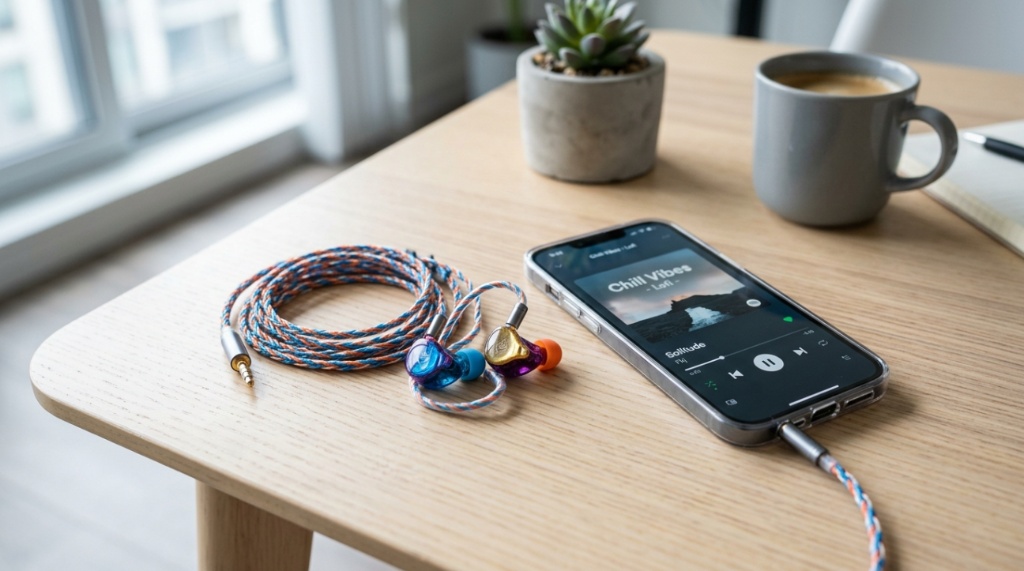
Even the most technically perfect IEM is useless if it hurts your ears after 30 minutes. The physical design of the IEM—its shell shape, weight, and nozzle angle—plays a massive role in long-term comfort. Because budget IEMs are often made in limited shell shapes, the fit varies significantly from person to person. A generic “universal fit” shell may work perfectly for one person and be agony for another.
Nozzle Size and Ear Tips
The nozzle (the tube you insert into your ear) is critical. If the nozzle is too wide (over 6mm), it can strain the ear canal entrance. If it is too short, the IEM might not sit securely. Always budget a few extra dollars for aftermarket ear tips (like CP100 or Spinfits). These can drastically improve both isolation and comfort. The stock tips included with budget IEMs are often subpar, so upgrading them is the cheapest way to improve the overall experience without changing the sound source.
Detachable Cables: A Smart Long-Term Investment
When comparing budget models, you should immediately check if the cable is detachable. This is arguably the most important durability feature. Non-detachable cables are a “use until they break” design. With a detachable cable (usually using a 2-pin or MMCX connector), if you snag the cable and snap it, or if the internal wiring shorts out, you can simply replace the cable for $10–$15 instead of buying a whole new pair of earphones. This feature alone can extend the life of your purchase by several years.
Connectivity Standards
While 2-pin is becoming the industry standard, you will still see MMCX connectors on some models. MMCX connectors rotate, which is great for fit but can sometimes become loose over time. 2-pin connectors are generally more secure and easier to replace. As you shop, ensure you know which standard the IEM uses so you can buy compatible replacement cables in the future. This is a specific detail often missed by buyers looking for the best budget IEM Washington retailers offer, but it is crucial for cost-per-year value.
Noise Isolation vs. Noise Cancellation
There is a critical distinction between passive noise isolation and active noise cancellation (ANC). IEMs are inherently fantastic at passive isolation because they create a physical seal inside your ear canal. This blocks out high-frequency noise (like chatter) very effectively without needing batteries or complex circuitry. ANC, on the other hand, is an electronic process that generates anti-noise waves to cancel out low-frequency hums (like engine noise).
In the budget segment, good ANC is very difficult to implement well. A $40 pair of ANC earbuds will often have “hissy” or “compressed” sound quality. For the same price, a passive IEM will block out a similar amount of noise and sound significantly better. If you are flying or commuting on a ferry, a properly sealed passive IEM will offer excellent isolation that is more consistent than cheap, battery-draining ANC alternatives.
Wired vs. Wireless: The Latency and Fidelity Trade-Off
While the world has shifted toward wireless, the term IEM specifically refers to wired in-ear monitors. Choosing a wired connection offers two distinct advantages: uncompressed audio quality and zero latency. For gaming or video editing, wireless earbuds often introduce a delay between the video and audio, which is distracting. Wired IEMs bypass this entirely. Furthermore, you do not have to worry about battery life draining on your flight from Sea-Tac to Spokane. The downside is, obviously, the physical tether to your device, which can be a nuisance if you are moving around a lot. If you choose a wireless option, you are looking at “TWS” (True Wireless Stereo) earbuds, which are a different category altogether and often lack the audio fidelity of a comparably priced wired IEM.
How to Test and Verify Before You Commit
Since you are in Washington, there are specific local advantages for testing audio gear—mainly the presence of specialty electronics retailers and a strong used market. While shopping online is convenient, nothing beats hearing a pair of headphones before you spend your money.
Local Retail Strategies
If you are in the Seattle or Bellevue area, you can visit dedicated audio stores to try out different models. Do not be afraid to bring your own music—specifically tracks you know well. Listen to the mids, the highs, and the bass response. Does the guitar strum sound natural? Are the vocals sibilant (harsh on “s” sounds)? Additionally, check audio forums or local craigslist listings; the Seattle-area used market for IEMs is often excellent, as tech workers frequently upgrade their gear, leaving lightly used budget models available at steep discounts.
The “A/B” Test
The best way to know if a budget IEM is right for you is to compare it directly against your current earphones. If the new pair does not sound noticeably better, send it back. Do not keep something just because it cost $45. Stepping up to a $30 IEM should be an upgrade over a standard $10 pair of earbuds. If you cannot notice the difference, the product isn’t doing its job, regardless of its specs.
Frequently Asked Questions
Are expensive IEMs worth the extra cost?
Beyond the $100–$200 mark, you experience diminishing returns. The jump from $20 to $50 is massive, but the jump from $100 to $500 is comparatively subtle. For most casual listeners, a $50 IEM will deliver 90% of the performance of a $500 model, mainly differing in technicalities like soundstage width and micro-detail retrieval.
Can I use IEMs for gaming on my PC?
Yes, wired IEMs are excellent for gaming because they have low latency and excellent imaging. They allow you to hear directional cues (footsteps, gunshots) clearly. Many gamers prefer IEMs over bulky gaming headsets, as they are lighter and more comfortable for long sessions, though you may need a separate microphone.
How do I increase the lifespan of my budget IEMs?
The most common cause of failure is physical strain on the cable near the connector or driver. Always unplug the IEM by pulling the connector, not the wire. Store them in a hard case to prevent dust from entering the nozzle and to avoid crushing the drivers.
Do I need a DAC or amplifier to use budget IEMs?
Not usually. Budget IEMs are highly sensitive and designed to be driven by smartphones or laptops. If you hear a “hissing” noise, your device’s internal audio chip might be noisy. A cheap USB-C dongle DAC (Digital-to-Analog Converter) can improve clarity and remove background hiss, but it is not a mandatory purchase.
Conclusion
Choosing the perfect budget IEM in Washington ultimately comes down to prioritizing sound tuning, comfort, and durability over marketing gimmicks. Start by identifying your preferred sound signature, then focus on models with detachable cables that offer the fitting style you need. Remember that the best budget IEM is not defined by its price tag, but by the amount of time you can comfortably wear it and how accurately it represents your favorite music. Avoid the trap of buying an overpriced pair with bright, harsh treble just because it looks brand-name. Instead, trust your ears and look for the balance that suits your daily audio needs in the Evergreen State.
